How to Choose the Best Off Grid Solar Lithium Battery?

Time:2026-10-05 Author:Amelia
0%

Choosing the best Off-Grid Solar Lithium Battery is not a simple shopping decision. It is a system-design decision involving sunlight, household loads, temperature, maintenance, and safety. The market is expanding quickly. The International Energy Agency’s Renewables 2024 report states that global battery storage additions more than doubled in 2023, reaching approximately 42 GW. This figure mainly reflects grid-connected projects, but it signals stronger manufacturing capacity and faster technology development for remote energy systems.

Off-grid users need more than a large capacity number. A cabin refrigerator, water pump, lights, and internet router may create sharp evening demand. Therefore, usable capacity, continuous power, surge power, cycle life, round-trip efficiency, and inverter compatibility deserve close attention. NREL’s 2024 Annual Technology Baseline shows that battery costs and performance vary by application, duration, and operating conditions. Lazard’s Levelized Cost of Storage analysis also highlights how project economics change with system design. These reports provide useful benchmarks, not universal answers.

No battery is perfect. A neat spreadsheet can still mislead. Field installers often find that cold temperatures, poor ventilation, undersized cables, or weak battery management settings reduce real-world performance. This guide explains how to compare lithium chemistry, depth of discharge, warranty terms, protection systems, and expansion options. It also considers practical standards, including IEC 62619 and IEC 63056, where applicable. The goal is not merely to choose the cheapest battery, but to match storage behavior with daily energy habits, local climate, and realistic maintenance access. Your actual loads matter most.
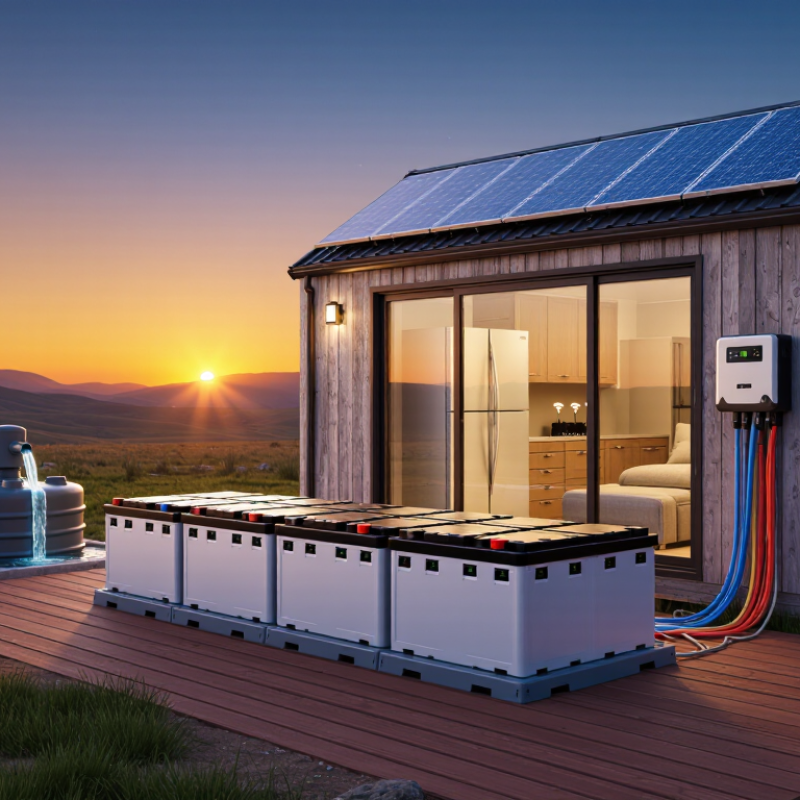
How to Choose the Best Off Grid Solar Lithium Battery?

## Define Off-Grid Loads, Autonomy, and a 1–3-Day Storage Target

Choosing an off-grid lithium battery starts with the loads, not the battery label. List every device, its wattage, operating hours, and starting surge. Include the refrigerator, water pump, lights, router, inverter standby draw, and seasonal equipment. A quiet 60-watt freezer running intermittently can consume more energy than several LED lamps.

Measure real usage when possible. Estimates often look too clean. The U.S. Department of Energy recommends using measured load profiles for storage planning, while NREL’s 2024 Annual Technology Baseline models lithium-ion battery round-trip efficiency near 85%. Therefore, a system needing 5 kWh daily may require more than 5 kWh of stored energy. Cold weather, conversion losses, and reserve capacity reduce usable output. Do not size from nominal capacity alone.

Autonomy describes how long the system operates without meaningful solar input. A 1–3-day target is practical for many cabins, but local weather should decide the number. NREL’s National Solar Radiation Database shows strong seasonal differences in solar availability across regions. A cloudy mountain site may need three days; a sunny desert site might manage one or two.

A useful planning equation is daily load × autonomy ÷ usable battery fraction. For example, 5 kWh per day, three days, and 80% usable capacity require about 18.75 kWh before additional design margins. That figure still needs review. Battery aging is easy to underestimate.

## Compare LFP and NMC Lithium Batteries by Safety, Life, and Energy Density

How to Choose the Best Off Grid Solar Lithium Battery?

For most off-grid homes, LFP lithium batteries offer a strong safety advantage. Their chemistry releases less heat during abuse or internal faults. A reliable battery management system remains essential. LFP cells also tolerate frequent charging and discharging. With proper temperature control, they often provide several thousand cycles. That suits cabins, workshops, and daily solar storage.

NMC batteries store more energy in a smaller and lighter package. This higher energy density helps when space is limited. A compact battery wall may hold substantial capacity in a narrow utility room. However, NMC chemistry needs stricter thermal monitoring and protective controls. High temperatures, overcharging, or physical damage can create greater safety concerns. The battery enclosure should remain dry, clean, and away from combustible materials.

Cycle life depends on more than chemistry. Deep discharges, freezing temperatures, and undersized cables can reduce real performance. Check the usable capacity, not only the advertised capacity. A 10 kWh battery may deliver less after reserve limits and conversion losses. LFP can be heavier and larger, which some installers underestimate. NMC may appear attractive, yet its shorter service life can increase replacement costs. I would not choose from energy density alone. Review the BMS settings, operating temperature range, warranty conditions, and installation records before deciding. During cloudy weeks, conservative power planning matters more than impressive laboratory figures.

How to Choose the Best Off-Grid Solar Lithium Battery?

Compare LFP and NMC Lithium Batteries by Safety, Life, and Energy Density

Comparison Dimension LFP Lithium Battery
(Lithium Iron Phosphate)
NMC Lithium Battery
(Nickel Manganese Cobalt)
Off-Grid Solar Implication
Nominal Cell Voltage Approximately 3.2 V per cell Approximately 3.6–3.7 V per cell Both chemistries can be configured into 12 V, 24 V, 48 V, and higher-voltage battery systems with an appropriate battery-management system.
Typical Gravimetric Energy Density Approximately 90–160 Wh/kg at cell level Approximately 150–250 Wh/kg at cell level NMC can provide a lighter and more compact battery for the same nominal energy capacity. For stationary solar storage, the weight advantage is often less important than service life and safety.
Typical Volumetric Energy Density Approximately 220–350 Wh/L at cell level Approximately 300–650 Wh/L at cell level NMC is useful where installation space is very limited. LFP generally requires more volume for the same rated kWh.
Thermal Stability and Safety Higher thermal stability and lower oxygen release during abuse conditions Lower thermal stability than LFP; requires careful thermal and electrical protection LFP is generally the preferred chemistry for homes, cabins, telecommunications sites, and other unattended off-grid installations. Safe design still requires a certified enclosure, fuses, a BMS, and correct installation.
Typical Cycle Life to Approximately 80% Capacity Approximately 3,000–7,000 cycles under suitable operating conditions Approximately 1,000–3,000 cycles under suitable operating conditions LFP normally provides more daily solar charge-discharge cycles and can reduce replacement frequency in systems used every day.
Recommended Routine Depth of Discharge Usually 80–90% usable capacity, subject to the manufacturer’s limits Usually 80–90% usable capacity, subject to the manufacturer’s limits Operating within the specified state-of-charge range improves battery life. A larger battery bank can reduce daily depth of discharge and provide additional cloudy-weather reserve.
Calendar Life Often approximately 10–15 years when stored and operated correctly Often approximately 8–12 years when stored and operated correctly Actual service life depends on temperature, charge voltage, time spent at full charge, cycling frequency, and battery-management quality.
Charge and Discharge Efficiency Typically about 90–98% round-trip efficiency at system level Typically about 90–98% round-trip efficiency at system level The efficiency difference between the chemistries is usually smaller than losses caused by the inverter, wiring, temperature, and partial-load operation.
Low-Temperature Charging Charging below 0°C is generally not recommended unless the battery has approved low-temperature protection or heating Charging below 0°C is generally not recommended unless the battery has approved low-temperature protection or heating For cold off-grid locations, select a battery with temperature sensors, charge cut-off protection, and an approved heating solution when necessary.
High-Temperature Operation High temperatures accelerate aging; cooling and ventilation are still required High temperatures accelerate aging and can increase safety risk; cooling and ventilation are especially important Install either chemistry away from direct sunlight and heat sources. Keep the battery within the manufacturer’s specified operating temperature range.
Power Capability Good power capability; depends on cell design and BMS current rating Good power capability; depends on cell design and BMS current rating Choose based on continuous and peak inverter loads, not chemistry alone. Check the battery’s continuous current, surge current, and inverter compatibility.
Maintenance Requirement Low maintenance; requires a compatible BMS and periodic system inspection Low maintenance; requires a compatible BMS and periodic system inspection Neither chemistry is maintenance-free from a system-design perspective. Inspect terminals, cables, ventilation, alarms, firmware, and temperature readings regularly.
Best-Fit Off-Grid Application Daily residential storage, cabins, remote power systems, backup power, and long-life solar banks Space- or weight-constrained installations, mobile systems, and applications where high energy density is the primary requirement For most stationary off-grid solar systems, LFP offers the stronger overall balance of safety, cycle life, and lifetime value. NMC may be preferable when available space or weight is severely restricted.
Overall Selection Priority Safety and longevity priority Compactness and lower weight priority Before choosing, compare usable kWh, warranty conditions, operating-temperature limits, BMS functions, certifications, inverter compatibility, and total cost over the expected service life.

Important: The figures above are representative ranges for commercial lithium-ion cells and battery systems, not guarantees for every product. Actual performance varies with cell format, construction, charge voltage, current, temperature, depth of discharge, battery-management settings, and installation quality.

Values should be verified against the technical datasheet and installation requirements of the specific battery system before purchase.

## Size Battery Capacity with 90–95% Efficiency and a 20% Reserve

How to Choose the Best Off Grid Solar Lithium Battery?

Battery capacity should match your real daily energy use, not an optimistic estimate. List appliances, their wattage, and operating hours. Include refrigeration, pumps, lighting, communication equipment, and inverter standby power. Add the daily totals in watt-hours. A practical design allows 90–95% system efficiency, because cables, battery management, and inverter conversion waste energy. Then keep 20% capacity in reserve for battery health and unexpected demand.

For example, a cabin using 3,000 watt-hours daily needs more than 3,000 watt-hours of storage. At 90% efficiency and an 80% usable limit, the calculation is 3,000 ÷ 0.90 ÷ 0.80, or about 4,167 watt-hours. Round upward when winter temperatures are low or cloudy weather lasts several days. Lithium batteries usually perform well, but their output can still change with temperature, age, and charging conditions. My field estimates often miss small loads. Standby power is easy to overlook.

Tips: Measure actual consumption with a plug-in energy meter for several days. Record the highest-use evening separately. Check the battery’s continuous discharge rating against your inverter. Confirm low-temperature charging protection and installation requirements with a qualified professional. A slightly larger battery may cost more, but replacing an undersized system is usually more disruptive. Recheck the calculation after a month of real use. Habits change. That matters.

How to Choose the Best Off-Grid Solar Lithium Battery?

Recommended nominal battery capacity for one day of energy autonomy, calculated with 92.5% system efficiency and a 20% reserve.

Battery capacity is sized using: Daily Energy Demand ÷ (Efficiency × 80% usable capacity). The 20% reserve helps protect battery life and provides additional energy during cloudy weather or unexpected demand.

## Verify BMS Ratings, Inverter Compatibility, Temperature Limits, and IP Protection

How to Choose the Best Off Grid Solar Lithium Battery?

Verify BMS Ratings, Inverter Compatibility, Temperature Limits, and IP Protection

A battery’s capacity is only part of the decision. Check the BMS continuous current rating against the inverter’s maximum demand. A 5 kWh battery may still fail if its BMS allows only 100 amps. NREL’s 2024 Annual Technology Baseline uses approximately 85% round-trip efficiency for lithium-ion storage, so wiring losses and conversion losses need room. I would also confirm surge ratings, communication protocols, and low-voltage shutdown settings before installation.

Compatibility problems often appear during cloudy mornings. The inverter must accept the battery’s voltage range and charging profile. Confirm whether CAN or RS485 communication is required. Do not rely on a generic “lithium mode.” It can be incomplete. The U.S. Department of Energy’s Energy Storage Handbook emphasizes thermal management and protective controls as key safety functions. Battery charging below 0°C can cause lithium plating unless the system includes heating or a proper lockout.

Enclosure protection matters outdoors. Under IEC 60529, IP65 means dust-tight protection and resistance to water jets; IP67 adds temporary immersion protection. Neither rating guarantees protection from condensation, salt air, or poor cable glands. Place the battery above likely flood levels and leave ventilation space. This sounds obvious. It is often missed. Check the full temperature specification, not only the operating range. Real installations may face a cold shed, direct summer sun, and uneven airflow. Test the BMS alarms before commissioning, because a perfect datasheet cannot correct a weak installation.

## Assess 3,000–7,000 Cycle Life, Warranty Terms, and Total Cost per kWh

Choosing an off-grid lithium battery requires more than comparing its advertised capacity. Cycle life is the practical starting point. A 3,000-cycle battery may serve over eight years at one daily cycle, while 7,000 cycles can exceed nineteen years. However, cycle ratings often assume moderate temperature and an exact depth of discharge. Real cabins may experience heat, cold, and deeper discharges. Test conditions matter.

Calculate total cost per delivered kilowatt-hour, not price per battery. For example, a 10 kWh unit costing $4,000, with 80% usable capacity and 5,000 cycles, provides about 40,000 kWh before considering losses. Its storage cost is roughly $0.10 per delivered kWh. Add the inverter, wiring, installation, monitoring, and eventual replacement. NREL’s 2024 Annual Technology Baseline places lithium-ion storage round-trip efficiency broadly near 85–95%, so usable output will be lower than the nameplate figure. Small losses become expensive in winter.

Read the warranty carefully. Check calendar years, cycle limits, throughput limits, minimum capacity, temperature exclusions, and service responsibilities. A ten-year warranty sounds strong, but it may end after a restricted energy throughput. BloombergNEF reported a global lithium-ion battery pack price of $115 per kWh in 2024, yet off-grid systems cost far more after electronics and installation. Lower price is not automatically better. I would also question unusually high cycle claims without independent testing.

FAQS

How should I estimate an off-grid battery’s required capacity?

List each appliance, wattage, operating hours, and starting surge. Include pumps, refrigerators, lights, routers, and inverter standby use.

Why should I measure real electricity use?

Estimates can look unusually neat. A freezer running intermittently may consume more energy than several LED lights.

What does battery autonomy mean?

Autonomy is the time your system operates without meaningful solar input. Many cabins plan for one to three days.

How does weather affect the storage target?

Cloudy mountain locations may need three days. Sunny areas may manage one or two days. Local conditions matter more than habit.

How can I calculate a basic storage target?

Multiply daily energy use by autonomy, then divide by usable battery capacity. Five kilowatt-hours daily for three days at 80% usable capacity needs about 18.75 kilowatt-hours.

Is nominal battery capacity the same as usable capacity?

No. Conversion losses, cold weather, reserve capacity, and aging reduce available energy. The calculation needs review.

How do I check battery and inverter compatibility?

Compare the battery management system’s continuous current rating with the inverter’s maximum demand. Confirm voltage range, surge ratings, and shutdown settings.

What communication details should I verify?

Check whether the inverter requires CAN or RS485 communication. A generic lithium setting may be incomplete. Test alarms before commissioning.

Can the battery charge below freezing?

Charging below 0°C can damage lithium cells. Use heating or a charging lockout when temperatures are too low.

Is an outdoor protection rating enough?

Not always. Dust and water ratings do not prevent condensation, salt air, flooding, or poor cable glands. Keep the battery elevated and ventilated. Safety depends on installation too.

Conclusion

Choosing the best Off-Grid Solar Lithium Battery starts with understanding your daily electrical loads, peak demand, and required autonomy. Estimate how much energy your appliances use, then plan for one to three days of storage based on weather conditions and backup needs. LFP batteries are often preferred for their strong safety profile and long service life, while NMC batteries may offer higher energy density. The right choice depends on available space, operating conditions, and system priorities.

To size the battery, account for approximately 90–95% system efficiency and keep a reserve of about 20% to avoid excessive discharge. Before purchasing, verify the battery management system ratings, inverter compatibility, temperature operating range, and IP protection level. Also compare expected cycle life, typically around 3,000–7,000 cycles, warranty coverage, maintenance requirements, and total cost per usable kilowatt-hour. A reliable battery should balance safety, performance, durability, and long-term value for your specific off-grid application.


Amelia

Amelia

Amelia is a seasoned marketing professional with a wealth of expertise in our company’s core offerings. With an unwavering passion for driving growth and innovation, she plays a pivotal role in shaping our marketing strategies and enhancing brand visibility. A key aspect of her responsibilities......