Top 10 Hybrid Energy Storage Solutions for Global Buyers

Time:2026-10-15 Author:Amelia
0%

Choosing the right Hybrid Energy Storage Solutions is no longer a simple matter of comparing battery capacity. Global buyers must consider safety, operating temperature, power demand, maintenance access, and local grid conditions. A solution that performs well in a coastal microgrid may struggle in a remote mining site. Context matters.

This guide reviews ten leading approaches for commercial, industrial, renewable, and backup applications. Each option is assessed through practical criteria, including energy density, response speed, cycle life, scalability, system integration, and total cost of ownership. We also consider manufacturer documentation, certification practices, monitoring functions, and real-world service requirements. A dependable system should not only store energy. It should remain understandable, serviceable, and stable under changing loads.

No ranking is universally correct. Some buyers may value fast frequency support, while others need long-duration storage during cloudy or windless periods. Hybrid systems can improve flexibility, yet they often introduce more controls, interfaces, and maintenance decisions. That complexity is easy to underestimate. Small design gaps can become expensive problems when temperatures rise, communication fails, or replacement parts take weeks to arrive. The following comparison therefore balances performance claims with practical limitations. It highlights where each technology fits, where it may disappoint, and which questions buyers should ask before signing a supply agreement. Reliable energy planning requires evidence, but also honest doubt.
Top 10 Hybrid Energy Storage Solutions for Global Buyers

Hybrid Storage Defined: 10 Architectures, 1–100+ Hours, 80–95% RTE

Top 10 Hybrid Energy Storage Solutions for Global Buyers

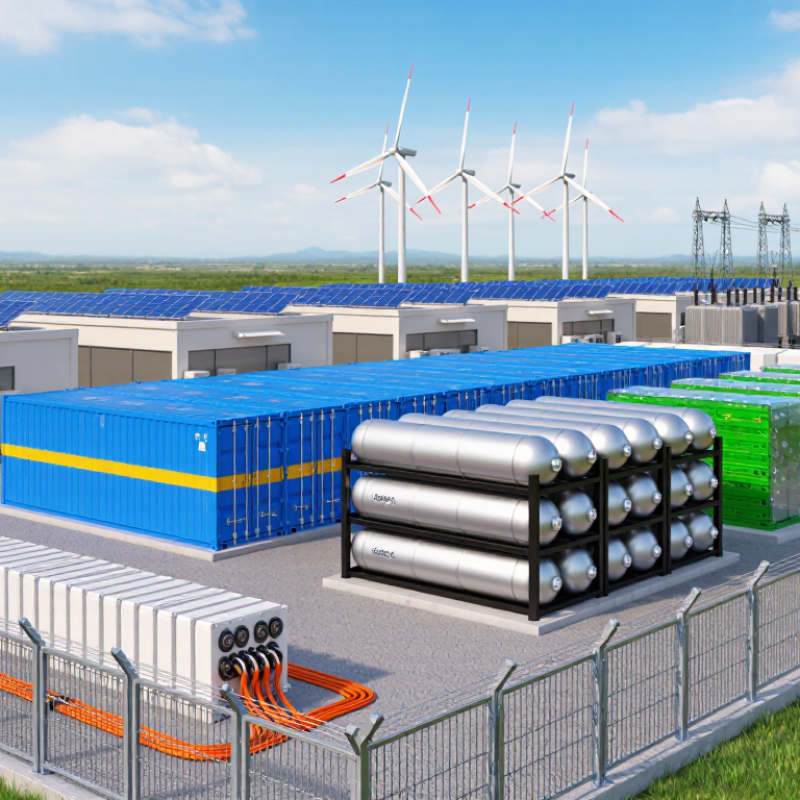
Hybrid storage combines technologies with different strengths. Common architectures include lithium-ion with solar, wind, flow batteries, sodium-ion, thermal storage, compressed air, pumped hydro, hydrogen, gravity systems, and battery-supercapacitor hybrids. These designs can serve applications from one hour to more than 100 hours. However, 80–95% round-trip efficiency is realistic mainly for shorter-duration battery systems, not every architecture.

The U.S. Department of Energy’s Long Duration Energy Storage Database identifies many systems lasting beyond 10 hours. Lazard’s Levelized Cost of Storage report shows that efficiency, project duration, and cycling frequency strongly affect delivered costs. The International Energy Agency reported that global battery storage additions reached about 42 GW in 2023, nearly doubling from the previous year. These figures support hybrid deployment, but comparisons remain imperfect. Different reports use different boundaries, degradation assumptions, and operating conditions.

Tips: Match the architecture to the duty cycle. Use batteries for fast response and daily cycling. Add flow, thermal, compressed-air, or hydrogen storage for longer discharge periods. Check temperature performance, fire protection, warranty terms, and replacement schedules. A high RTE number can look attractive, yet it may exclude auxiliary loads and conversion losses. Buyers should request measured field data, not only laboratory results. Even experienced engineers can underestimate integration losses. That deserves a second review.

Solar–Battery and Wind–Battery Systems: 2–8 Hours, 80–95% RTE

Top 10 Hybrid Energy Storage Solutions for Global Buyers

Solar–battery and wind–battery systems are becoming practical assets for sites needing two to eight hours of dispatchable energy. Solar charging usually peaks at midday, while wind generation may continue through the night. A shared battery can reduce curtailment, smooth output, and support local demand during grid interruptions.

The strongest designs combine lithium-based battery racks, bidirectional power conversion, and an energy management system. AC-coupled systems suit existing solar or wind plants. DC-coupled layouts can reduce conversion losses when equipment is planned together. Buyers should request measured round-trip efficiency, not only a brochure estimate. System-level RTE commonly ranges from 80% to 95%, depending on temperature, inverter loading, standby use, and operating duration.

Details matter. A two-hour battery may deliver high power for evening peaks, while an eight-hour unit supports overnight wind variability. Container ventilation, fire separation, drainage, and service access should be checked during the site survey. Commissioning teams should test black-start functions, state-of-charge accuracy, protection settings, and repeated charge-discharge cycles. Hard evidence matters.

A quoted 95% RTE may reflect ideal laboratory conditions. Real projects often perform lower. That is not necessarily failure, but buyers should understand why. Degradation, dust, weak grid connections, and poor control logic can change results. Long-term contracts should define usable capacity, availability, response time, warranty testing, and data ownership in clear language.

Top 10 Hybrid Energy Storage Solutions for Global Buyers - Solar–Battery and Wind–Battery Systems: 2–8 Hours, 80–95% RTE

Indicative system-level specifications for utility-scale and commercial renewable-plus-storage projects. Actual performance depends on operating temperature, auxiliary loads, power-conversion equipment, dispatch strategy, and warranty conditions.
Rank Hybrid Solution Renewable Pairing Storage Technology Typical Duration Typical RTE Common Project Scale Response Time Best-Fit Use Case
01 Solar + 2-Hour LFP Battery Utility solar PV Lithium iron phosphate (LFP) 2 hours 88–94% 1–100+ MW / 2–200+ MWh Milliseconds to seconds Solar ramp control, frequency regulation, and short evening peak support
02 Solar + 4-Hour LFP Battery Utility and commercial solar PV Lithium iron phosphate (LFP) 4 hours 88–94% 1–200+ MW / 4–800+ MWh Milliseconds to seconds Daily solar shifting, capacity support, and evening peak reduction
03 Solar + 2-Hour NMC Battery Solar PV in space-constrained sites Nickel manganese cobalt (NMC) 2 hours 90–95% 1–50 MW / 2–100+ MWh Milliseconds to seconds High power density, fast ancillary services, and constrained land availability
04 Solar + 4-Hour Sodium-Ion Battery Solar PV and distributed solar Sodium-ion battery 4 hours 85–92% 0.5–50 MW / 2–200+ MWh Milliseconds to seconds Cost-sensitive projects, cold-weather applications, and daily load shifting
05 Solar + 6-Hour Vanadium Flow Battery Utility solar PV Vanadium redox flow battery 6 hours 80–85% 1–100 MW / 6–600+ MWh Sub-second to seconds High-cycle solar shifting and applications prioritizing long service life
06 Wind + 4-Hour LFP Battery Onshore or offshore wind Lithium iron phosphate (LFP) 4 hours 88–94% 1–200+ MW / 4–800+ MWh Milliseconds to seconds Wind forecast balancing, congestion management, and firming
07 Wind + 8-Hour LFP Battery Onshore wind and hybrid wind parks Long-duration LFP battery system 8 hours 86–92% 10–200+ MW / 80–1,600+ MWh Milliseconds to seconds Overnight wind shifting, renewable firming, and transmission support
08 Wind + 8-Hour Vanadium Flow Battery Onshore wind and remote wind projects Vanadium redox flow battery 8 hours 80–85% 5–100 MW / 40–800+ MWh Sub-second to seconds Frequent deep cycling, multi-hour wind firming, and remote-grid resilience
09 Solar–Wind + 4-Hour Hybrid LFP Battery Co-located solar PV and wind Lithium iron phosphate (LFP) 4 hours 88–94% 10–300+ MW / 40–1,200+ MWh Milliseconds to seconds Smoothing complementary solar and wind profiles while improving grid-connection utilization
10 Solar–Wind + 6-Hour Sodium–Sulfur Battery Utility solar PV and wind High-temperature sodium–sulfur battery 6 hours 80–90% 1–100 MW / 6–600+ MWh Seconds Multi-hour renewable shifting where compact, stationary storage is preferred
RTE: Round-trip efficiency, measured as usable energy discharged divided by energy charged. The ranges shown are indicative AC-side values for complete storage systems rather than cell-level efficiency.

Pumped-Hydro, Thermal, and Hydrogen Hybrids: 10–100+ Hour Duration

Top 10 Hybrid Energy Storage Solutions for Global Buyers

Pumped-Hydro, Thermal, and Hydrogen Hybrids: 10–100+ Hour Duration

Long-duration storage is becoming essential as renewable generation expands. Global buyers need systems that deliver power through overnight gaps, cloudy weeks, or seasonal demand. Pumped-hydro hybrids combine elevated reservoirs with batteries for fast response and long discharge periods. Water moves between two basins, while batteries handle sudden frequency changes. This design can support ten hours to several days of operation. Geography matters.

Thermal hybrids store energy as heat in insulated tanks, solid media, or underground formations. They can supply industrial steam, district heating, or electricity through a thermal engine. A real project may include solar generation, heat storage, and a smaller battery. This reduces battery cycling and protects high-value cells from unnecessary wear. However, thermal-to-electric efficiency can be modest. Buyers should measure the complete energy pathway, not only storage capacity.

Hydrogen hybrids offer duration beyond one hundred hours when paired with electrolysis, storage vessels, and fuel cells or turbines. They can absorb surplus renewable power and provide backup during extended shortages. Site reviews should examine water availability, compression needs, safety controls, and conversion losses. Hydrogen storage may fit remote grids, ports, and industrial facilities, but infrastructure costs remain significant.

No hybrid is perfect. A spreadsheet can hide difficult maintenance, uncertain weather, and slow permitting. Strong procurement teams compare round-trip efficiency, response time, degradation, local skills, and ten-year operating data before choosing a configuration.

Flow-Battery, Flywheel, Supercapacitor, and EV Hybrids: Millisecond Response

Global buyers are shifting toward hybrid energy storage because one technology rarely handles every grid duty well. The International Energy Agency reported that global battery demand reached about 750 GWh in 2023, driven mainly by electric vehicles. Yet batteries alone can struggle with repeated power spikes, thermal stress, and short dispatch intervals.

Flywheels and supercapacitors respond within milliseconds, making them suitable for frequency regulation, voltage support, and factory ride-through systems. The U.S. Department of Energy identifies flywheels as high-power assets with rapid cycling capability. Supercapacitors react even faster, often within milliseconds, but their energy duration remains limited. They are powerful, not patient. Flow batteries can supply longer-duration energy with lower degradation during frequent cycling. Their tanks, pumps, and electrolyte management add practical complexity.

EV hybrids create another useful layer. Bidirectional chargers can connect vehicle batteries with buildings or microgrids, while supercapacitors absorb sudden acceleration and braking peaks. The IEA’s Global EV Outlook 2024 projects continued rapid electric-vehicle growth, increasing the potential for managed vehicle-to-grid capacity. However, availability is uncertain. Drivers may unplug unexpectedly. That weakness needs honest modelling. A practical portfolio may combine flywheel response, supercapacitor surge control, flow-battery duration, and EV flexibility. Independent testing should verify response time, round-trip efficiency, degradation, safety controls, and performance under heat. Reports from the National Renewable Energy Laboratory also show that operating strategy strongly affects storage value, so software deserves as much scrutiny as hardware.

Global Buyer Scorecard: LCOS, IEC 62933, and IEA’s 1,200-GW 2030 Need

Global buyers need more than a promising storage capacity figure. The IEA’s projected 1,200-GW global need by 2030 raises pressure on cost, safety, and delivery reliability. A useful scorecard compares levelized cost of storage, or LCOS, with local grid conditions. It should also include cycle life, round-trip efficiency, degradation, and replacement costs.

LCOS can expose hidden expenses. However, it is not a perfect forecast. Electricity prices, financing rates, and operating temperatures can change the result quickly. A battery-plus-thermal system may reduce peak demand charges in a hot industrial site. A battery-plus-hydrogen configuration may support longer outages, but conversion losses can weaken its economics. Short tests often miss these differences.

IEC 62933 should be treated as a standards family, not a single approval label. Buyers should request documented testing, hazard analysis, operating limits, and maintenance procedures. Site teams can check enclosure temperatures, fire separation, noise, and emergency access during a physical inspection. Ask for measured performance at partial load, not only laboratory ratings. Procurement teams should also verify recycling pathways and spare-part availability across borders. The scorecard needs uncertainty bands, because projected LCOS may look precise while relying on fragile assumptions. That is where many comparisons become misleading. An imperfect model is still useful when its weaknesses are visible.

FAQS

What is a hybrid energy storage system?

It combines technologies with different strengths. One may respond quickly, while another stores energy for many hours.

How do pumped-hydro and battery systems work together?

Elevated water reservoirs provide long discharge periods. Batteries manage sudden frequency changes and short power spikes.

What site conditions does pumped-hydro storage require?

The project needs suitable elevation, water access, and stable geology. Geography matters greatly.

When are thermal storage hybrids useful?

They can store heat in insulated tanks, solid materials, or underground formations. Industries may use the heat directly for steam.

Why might thermal storage include a smaller battery?

The battery handles brief changes. This reduces repeated cycling and may protect expensive cells from unnecessary wear.

What should buyers check before choosing thermal storage?

Measure the full energy pathway. Thermal-to-electric efficiency can be modest, even when storage capacity looks impressive.

Can hydrogen hybrids provide very long-duration backup?

Yes. Electrolysis, storage vessels, and fuel cells can support shortages lasting over one hundred hours.

What challenges can hydrogen storage create?

Buyers should examine water supply, compression, safety controls, and conversion losses. Infrastructure costs may remain high.

Which technologies provide millisecond responses?

Flywheels and supercapacitors respond very quickly. They support frequency control, voltage stability, and factory ride-through needs.

How can flow batteries and electric vehicles support hybrid storage?

Flow batteries provide longer cycling duration. Bidirectional vehicle chargers can connect parked vehicles with buildings or microgrids.

Is vehicle-based storage always dependable?

No. Drivers may unplug unexpectedly. That weakness needs honest modelling.

What should procurement teams compare over ten years?

Compare response time, round-trip efficiency, degradation, maintenance, safety, local skills, and operating data. Software deserves equal scrutiny.

Conclusion

Hybrid Energy Storage Solutions combine different storage technologies to balance power, duration, efficiency, and response speed. This article compares ten practical architectures, from solar–battery and wind–battery systems offering roughly 2–8 hours of storage at 80–95% round-trip efficiency to pumped-hydro, thermal, and hydrogen hybrids designed for 10–100+ hour applications. It also examines flow-battery, flywheel, supercapacitor, and electric-vehicle-integrated systems, which can deliver millisecond-level responses for frequency regulation, peak management, and grid stability.

For global buyers, selecting the right solution requires more than comparing capacity. Key evaluation factors include levelized cost of storage, project duration, operating environment, safety, scalability, maintenance needs, and compliance with IEC 62933 and other applicable standards. The article also places these technologies in the context of the International Energy Agency’s projected need for approximately 1,200 GW of global energy storage by 2030, helping buyers identify systems that align with renewable integration goals, reliability requirements, and long-term economic performance.


Amelia

Amelia

Amelia is a seasoned marketing professional with a wealth of expertise in our company’s core offerings. With an unwavering passion for driving growth and innovation, she plays a pivotal role in shaping our marketing strategies and enhancing brand visibility. A key aspect of her responsibilities......